
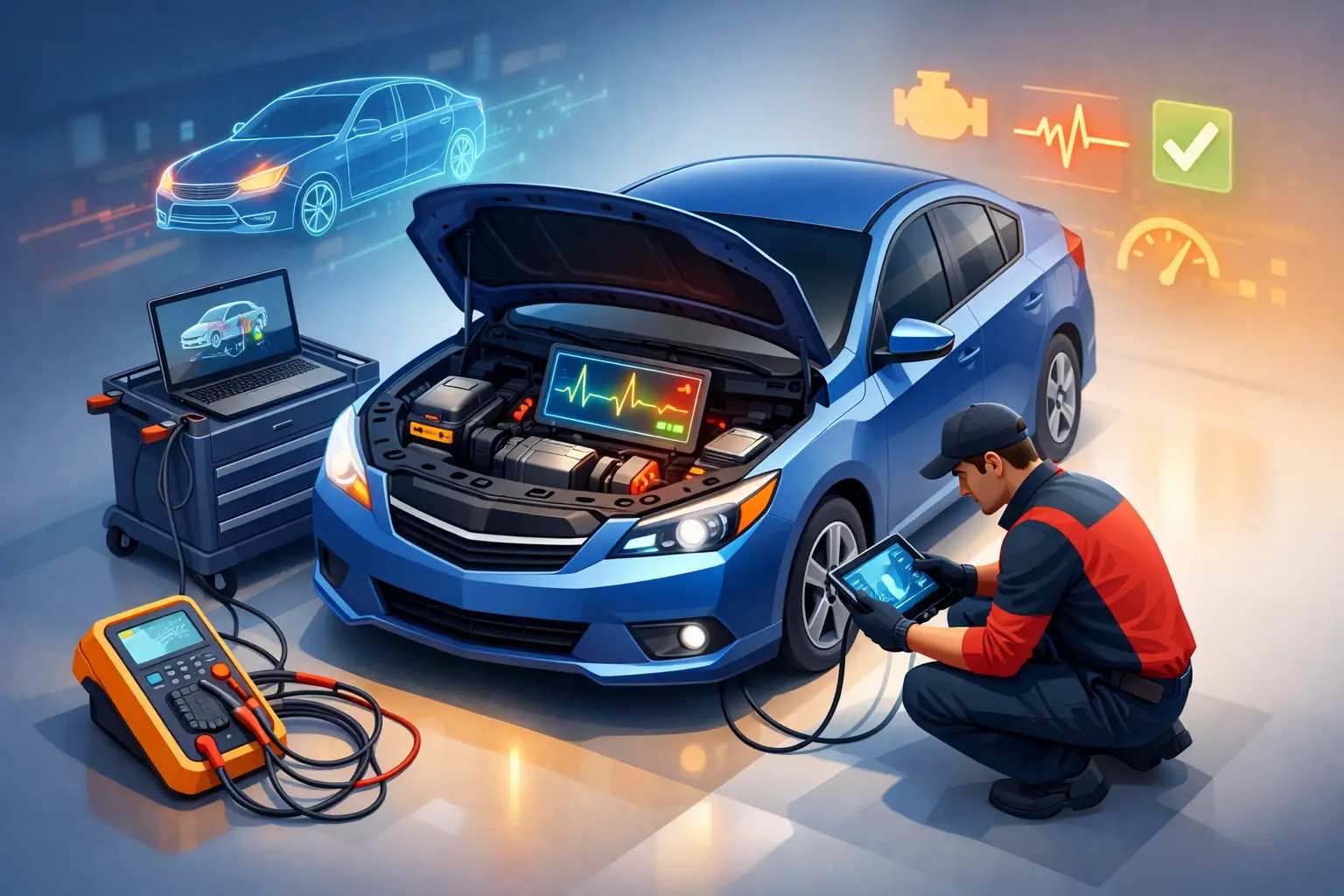
A warning light comes on, the truck won’t start, the trailer lights drop out, or the battery keeps going flat for no clear reason. This is where vehicle electrical diagnostics matter. Good diagnostics do more than confirm there’s a fault – they identify where the problem starts, what else it affects, and what needs to be repaired now versus what can wait.
For commercial operators, time off the road costs money. For private vehicle owners, electrical faults are frustrating because they often look random. A flat battery might be a battery issue, but it could also be a charging fault, a parasitic draw, a bad earth, damaged wiring, or a module that isn’t shutting down properly. Replacing parts without proper testing usually costs more in the long run.
What vehicle electrical diagnostics actually covers
Electrical diagnostics is the process of testing a vehicle’s charging, starting, wiring, control modules and related systems to locate faults accurately. On a modern car, ute, truck or trailer, that can include the battery, alternator, starter motor, lighting circuits, brake controllers, trailer plugs, air conditioning controls, alarms, sensors and computer systems.
The key point is that diagnostics is not guesswork. A technician uses testing equipment and fault-finding methods to measure voltage, current, resistance and communication between systems. Fault codes can help, but they are only one part of the picture. A code may point to a symptom, not the actual cause.
That matters even more on heavy vehicles and fleet units. Trucks and trailers often run extra lighting, telematics, liftgates, refrigeration units, work lamps, inverters and accessory wiring. The more equipment fitted to the vehicle, the more potential there is for voltage drop, poor connections or faults caused by previous repairs and add-ons.
Why proper vehicle electrical diagnostics saves money
The cheapest repair is not always the lowest invoice on the day. If a workshop swaps parts based on suspicion, you can end up paying for a battery, alternator or sensor that was never the issue. Then the vehicle comes back with the same problem, and downtime stretches out.
Proper vehicle electrical diagnostics reduces that risk. It narrows the fault before parts are fitted, which means fewer repeat visits and less disruption. For fleet managers, that’s a practical benefit. A unit that is diagnosed properly the first time is more likely to return to service quickly and stay there.
There is also a safety angle. Faulty lighting, trailer connections, battery cables and charging systems are not just inconvenient. They can lead to breakdowns, non-compliance and unsafe operation, especially when vehicles are working long hours or carrying loads.
Common faults that need accurate diagnosis
Some electrical issues are obvious. A battery that has failed a load test and won’t hold charge is fairly straightforward. Others are more difficult because the fault comes and goes or only appears under load.
Intermittent no-start problems are a good example. The battery may test fine in the workshop, but the real issue could be a poor terminal connection, starter current draw, an ignition switch fault or a voltage drop on the main cable. Without proper testing, it is easy to miss.
Lighting faults are another common one. On trailers, the cause might be damaged wiring, corrosion in the plug, a poor earth or a fault in the towing vehicle rather than the trailer itself. On commercial vehicles, repeated globe failure can point to vibration, charging voltage problems or water ingress.
Battery drain is often the most frustrating fault of all. If a vehicle goes flat overnight or after sitting for a day or two, the cause could be a module staying awake, an aftermarket accessory drawing power, a relay sticking, or a charging system that is only partly doing its job. These faults need time, method and the right equipment to trace properly.
How a proper diagnostic process works
A sound diagnostic process starts with the basics. Complaint first, test second, parts later. That means confirming what the vehicle is doing, when the fault occurs, and whether it is constant or intermittent. For fleet vehicles, driver feedback is useful because patterns often point to the real cause.
From there, the technician checks battery condition, charging performance, cable integrity, fuses, earth points and visible wiring. Scan tools are then used where relevant to read codes, live data and system behaviour. But scan data alone is not enough. Physical electrical testing still matters, particularly on starting and charging systems.
If the fault is intermittent, the job can take longer. That is not poor efficiency – it is the reality of tracking down a fault that only appears with vibration, heat, load or time. The right approach is to prove the issue before replacing components. That can mean current draw testing, voltage drop testing, circuit isolation and inspection of previous repairs or accessory installations.
Modern vehicles need more than a code reader
A lot of people assume diagnostics means plugging in a scanner and reading a fault code. On some jobs, that helps. On many others, it barely scratches the surface.
Modern vehicles have complex electrical architecture. Systems talk to each other, and one fault can trigger another. A low-voltage condition might cause multiple warning lights, communication faults and performance issues even though the root problem is a weak battery connection or charging fault. If you only clear codes or replace the part named in the code, you risk missing the real issue.
That is why specialist auto electrical work is different from general servicing. It takes equipment, but it also takes experience. Knowing how electrical faults behave on trucks, trailers and commercial vehicles makes a difference, especially when the vehicle has already been seen elsewhere and the problem still isn’t fixed.
The mobile advantage for breakdowns and fleet work
Not every fault happens at a convenient time or place. A truck that won’t crank at a yard, a trailer with no lights before a job, or a van with a charging issue on site usually needs attention where it sits. In those cases, mobile support is not just convenient – it can be the fastest way to get the vehicle moving again.
That is particularly useful in Auckland traffic and for operators managing multiple vehicles across different sites. A mobile auto electrician can test the fault on location, confirm whether it is a battery, charging or wiring issue, and in many cases carry out the repair there and then. If workshop time is needed, the diagnosis has already started, which helps speed up the next step.
For fleet customers, that matters. Faster diagnosis means less standing time, better planning and fewer disruptions to the day’s jobs. Simms Electrical supports that with workshop service and mobile field coverage, which is often the practical difference between a minor delay and a full day lost.
When to book diagnostics before the fault gets worse
Some electrical problems announce themselves early. Slow cranking, dim lights, intermittent warning lamps, battery corrosion, trailer lights that work only sometimes, air conditioning controls playing up, or accessories cutting out under load are all worth checking before they turn into a breakdown.
The same applies if you’ve already replaced a battery and the issue returned. That usually means the battery was a victim, not the cause. Charging faults, poor cables and current drain problems do not fix themselves.
For commercial vehicles, routine checks make sense if uptime is critical. Vehicles that do heavy kilometres, frequent stop-start work or run a lot of accessories place more demand on the electrical system. Preventive testing can catch charging weakness, worn cables and failing components before they stop a vehicle on the road.
Choosing the right workshop for electrical fault finding
Not every workshop handles electrical work to the same level. If the issue is straightforward, many places can fit a battery or globe. If the problem is intermittent, repeated, or affecting multiple systems, specialist diagnosis is usually the better option.
Look for a provider with proper diagnostic equipment, experience across cars and commercial vehicles, and the ability to support both workshop repairs and field call-outs. Breadth matters too. If the same team can diagnose, repair, source quality parts and support fleet requirements, the process is usually quicker and cleaner.
The best result is not just getting the fault to disappear for a day. It is understanding what failed, fixing it properly, and reducing the chance of seeing the same issue again.
If your vehicle is showing electrical faults, the smartest move is usually the simplest one – test it properly before spending money on parts you may not need.