
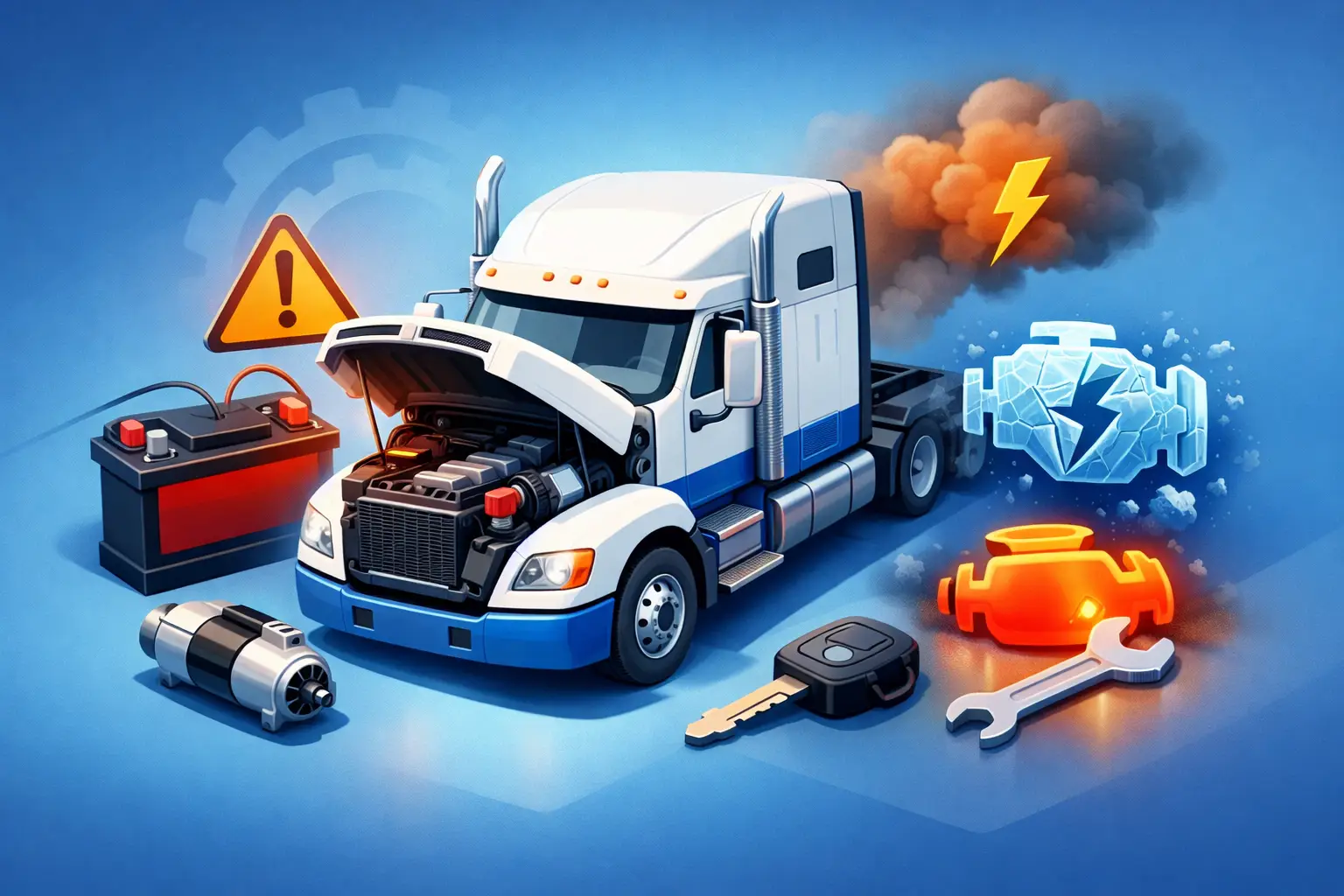
A truck that will not start at 5:30 in the morning is not a small inconvenience. It means missed runs, delayed staff, unhappy customers and a vehicle sitting idle when it should be earning. Truck starting problems are often treated like a simple battery issue, but in practice the fault can sit anywhere in the starting or charging system, and guessing usually costs more time than proper testing.
Common truck starting problems
Most starting faults fall into a handful of patterns. The truck may crank slowly, click once and stop, crank normally but not fire, or show no response at all when the key is turned. Each symptom points in a slightly different direction, which is why a proper diagnosis matters.
A slow crank often suggests low battery voltage, poor cable connections or high resistance in the circuit. A single click can indicate a weak battery, a faulty starter solenoid or poor power delivery to the starter. If the engine cranks strongly but does not start, the fault may be outside the starter circuit altogether and involve ignition, fuel supply or engine management inputs. No dash lights and no crank usually point to a flat battery, a bad connection, an isolation switch issue or a main power supply fault.
This is where heavy vehicle experience makes a difference. On a truck, there is often more than one battery, longer cable runs, more vibration, more exposure to weather and more electrical load than you get in a standard passenger vehicle. The system is under more stress, so faults are not always obvious at first glance.
The battery is common, but not always the whole story
A failing battery is still one of the most common causes of truck starting problems, especially in vehicles that do short runs, sit unused for periods or power accessories overnight. But replacing the battery without testing the system can be an expensive way to miss the real fault.
Batteries can lose capacity with age, but they can also be drained by parasitic current draw, poor charging, faulty alternator output or repeated deep discharge. In colder weather, a battery that was already marginal can suddenly stop coping with the load. In warmer conditions, heat can shorten battery life over time, particularly in engine bays and under constant commercial use.
On heavy vehicles, battery condition should be checked properly, not just judged by whether lights still come on. A battery may have enough voltage to power the dash and still fail under load when the starter demands current. Load testing, terminal inspection and charging system checks are what separate a quick guess from a reliable answer.
Starter motor and solenoid faults
When the battery is sound but the engine still will not crank properly, the starter motor and solenoid move up the list. These components work hard, particularly on commercial vehicles with frequent stop-start use.
A worn starter motor may crank intermittently, draw excessive current or fail completely. Solenoids can stick, burn contacts or fail to engage the starter gear consistently. Sometimes the truck starts after a few attempts, which leads people to put the problem off. That usually ends with a no-start at the least convenient time.
The trade-off here is straightforward. If a starter is beginning to fail, you might still get a few more starts out of it. But if the vehicle is part of a working fleet, waiting for total failure rarely makes sense. Planned repair is almost always cheaper than downtime on a job.
Wiring, terminals and earth faults
Electrical faults are often blamed on major components when the real issue is in the wiring between them. Corroded battery terminals, loose lugs, damaged cables and poor earth connections are a regular cause of truck starting problems.
Heavy vehicles operate in harsh conditions. Moisture, road grime, vibration and heat all take their toll. A cable can look acceptable from the outside and still have internal corrosion or broken strands creating voltage drop under load. Earth faults are especially common and can produce inconsistent symptoms that come and go.
This is one of the reasons mobile diagnostics are useful when a truck is off the road. The problem may not be a single failed part. It may be a connection issue that only shows itself under starting load, and that needs testing at the vehicle rather than assumption from a distance.
Charging system faults that create repeat no-starts
If a truck needs jump starting more than once, the battery may not be the cause. The charging system needs attention. An alternator that is undercharging, overcharging or charging inconsistently can leave even a new battery unable to do its job.
Undercharging gradually leaves the batteries short of reserve. Overcharging can damage them and shorten service life. Faults in regulators, wiring, belts or connections can all affect charging performance. On modern vehicles, smart charging systems and control modules add another layer, which means the fix is not always as simple as swapping out the alternator.
This matters for fleet operators in particular. If one truck repeatedly comes back with flat batteries, there is usually a wider issue than battery age alone. Identifying that early can prevent avoidable battery replacement across multiple units.
When the problem is not the starting system
Not every no-start is a cranking fault. If the engine turns over properly but does not fire, the cause may sit elsewhere. Faulty sensors, immobiliser issues, blown fuses, ignition faults and power supply problems to control modules can all stop a truck from starting.
On newer vehicles, fault codes can help, but they should not be taken in isolation. A code may point to a symptom rather than the root cause. On older vehicles, the issue may be more mechanical or tied to simpler wiring faults. Either way, the right approach is testing, not parts swapping.
For operators, the key point is simple. Crank-no-start and no-crank are different problems, and they should be treated differently. Grouping them together as “it won’t start” is understandable, but it can slow diagnosis if the symptoms are not clear.
What to check before calling for help
There are a few practical checks worth doing before arranging a repair. Look for obvious battery terminal corrosion, loose leads, isolation switch issues and whether the dash powers up normally. Listen to what happens when the key is turned. A click, slow crank or complete silence each tells a different story.
If the truck has had repeated jump starts, note that as well. If accessories were left on, mention it. If the fault happens only first thing in the morning or after rain, that is useful information. These details save time because they narrow the testing path.
That said, there is a point where trying to push through becomes counterproductive. Repeated jump starts can stress the system. Randomly replacing batteries, starters or relays without confirming the fault can become more expensive than a proper inspection.
Why proper diagnostics save time
With truck starting problems, speed matters, but speed without accuracy is not much use. Proper diagnostics check battery condition, voltage drop, starter current draw, alternator output, parasitic drain and circuit integrity. That gives a clearer answer than replacing the most obvious part and hoping for the best.
For commercial operators, this is not just about fixing one breakdown. It is about reducing repeat failures. A truck that starts reliably every day is one less disruption to scheduling, deliveries and staff time. For owner-drivers and tradespeople, it is about getting moving again without chasing the same fault next week.
This is also where specialist support matters. Trucks and commercial vehicles are not just larger versions of cars. The systems are heavier duty, the usage patterns are different and the consequences of downtime are higher. A one-stop auto electrical shop with workshop support, mobile service and the right diagnostic gear can often get to the fault faster because it sees these problems every day.
When to get an auto electrician involved
If the battery is going flat repeatedly, the truck only starts intermittently, there is a click with no crank, or the issue has already outlasted one replacement part, it is time for proper testing. The same applies if the vehicle cannot be moved and downtime is costing money.
For Auckland operators, mobile support can be the difference between a long delay and a same-day fix. Simms Electrical handles this kind of work across trucks, trailers and commercial vehicles, whether the issue is a battery, starter, charging fault or a harder-to-find wiring problem.
A truck that fails to start is usually giving you a warning before it leaves you stranded completely. The practical move is to get it tested while the fault is still intermittent, not after it becomes tomorrow morning’s problem.