
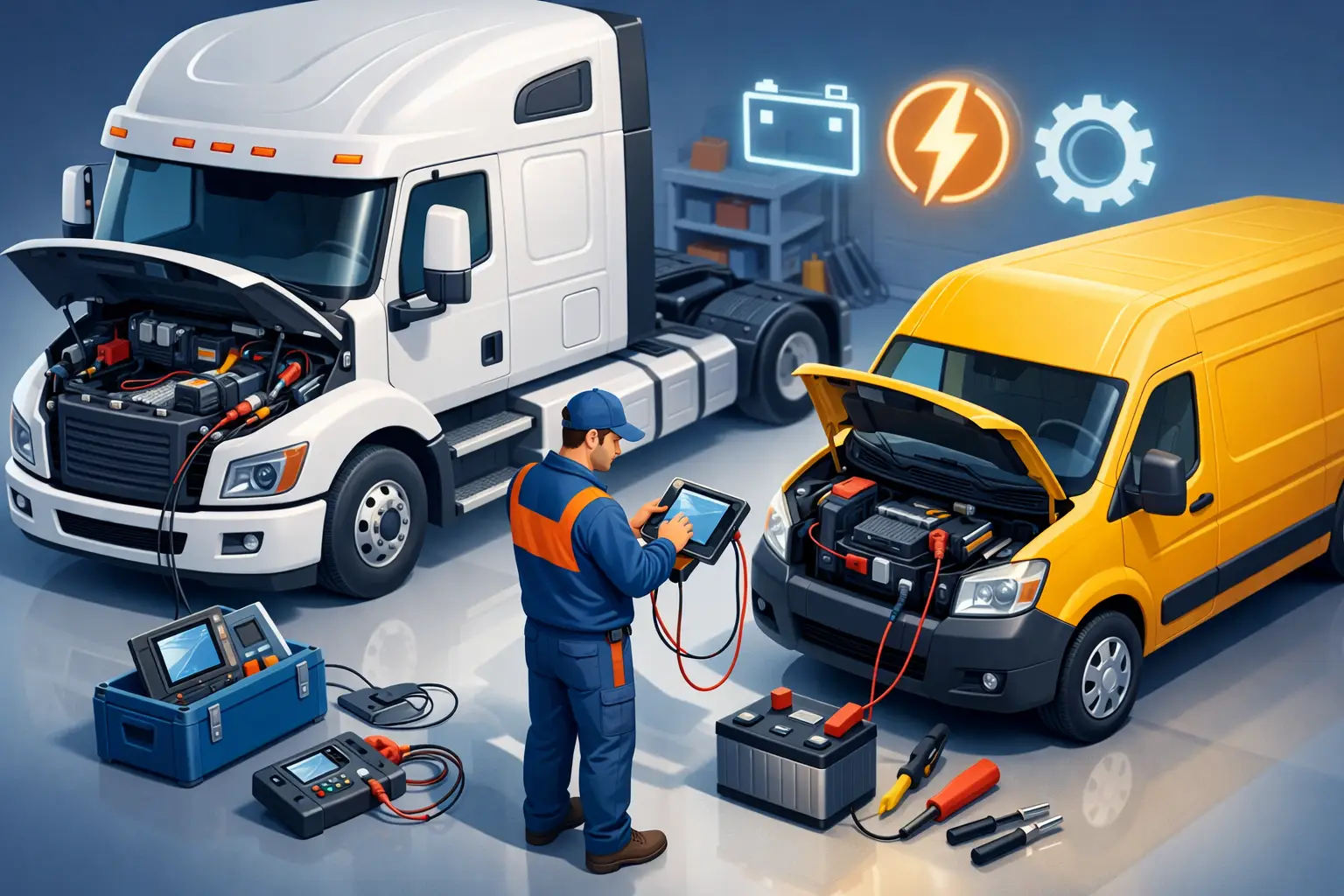
A truck that will not start at 5:30 am, trailer lights dropping out before a delivery run, or a battery that fails after a cold night – this is where a commercial vehicle electrical maintenance guide earns its keep. For fleet operators, owner-drivers and tradespeople, electrical faults are rarely minor. They cost time, disrupt schedules and can take a vehicle off the road with very little warning.
The good news is that most major electrical failures do not come out of nowhere. They usually start as small signs – slower cranking, dim lighting, intermittent faults, corroded terminals, damaged wiring or repeated battery replacements. Catch those early and you reduce breakdowns, call-outs and lost working hours.
What this commercial vehicle electrical maintenance guide should help you prevent
Commercial vehicles work harder than private cars. They deal with vibration, moisture, dust, long operating hours, stop-start conditions and heavy accessory loads. Add lifts, beacons, refrigeration units, trailer connections, in-cab systems and aftermarket equipment, and the electrical system has a lot to carry.
That is why maintenance has to be practical rather than theoretical. The goal is not just to keep components clean. It is to stop small faults from turning into roadside failures, compliance issues or damage to more expensive parts.
A sound maintenance routine helps prevent battery failure, charging system problems, lighting faults, poor earths, damaged looms, trailer plug issues and parasitic drain. It also gives you a clearer picture of whether a vehicle needs workshop attention now or can stay in service until its next booked inspection.
Start with the parts that fail most often
If you are responsible for one vehicle or a whole fleet, begin with the common pressure points. Batteries are the obvious one, but they are not always the root cause. A battery that keeps going flat may be old, but it may also be undercharged, overworked or affected by a faulty alternator, damaged cable or constant current draw.
Battery terminals should be clean, tight and free from corrosion. Mountings matter too. A battery that shifts under vibration will not last, and loose clamps can damage the case or cables. Check for swelling, leaks and slow cranking. Those are signs to act before the vehicle is stranded.
Charging system checks are just as important. If the alternator is not maintaining proper charge, every electrical component downstream becomes less reliable. Dash warnings, weak starting and inconsistent accessory performance often point to charging issues. This is where proper diagnostic testing matters, because guessing usually leads to wasted parts and repeat failures.
Lighting is another major problem area, especially on trucks, trailers and service vehicles. Marker lamps, brake lights, indicators, work lights and beacons are exposed to weather, impact and vibration. One failed lamp might seem minor, but repeated lighting faults can point to poor earths, water ingress or connector damage rather than a bad globe alone.
Wiring and connections deserve more attention than they usually get
A lot of electrical trouble comes down to wiring condition. On commercial vehicles, harnesses are constantly exposed to heat, movement, sharp edges and road grime. Trailer wiring is even more vulnerable because of repeated connection and disconnection, plus the extra strain placed on plugs and sockets.
Look for rubbed insulation, stretched cables, cracked conduit and green corrosion at connectors. Check where looms run near chassis rails, hinges, moving parts and mounting brackets. If a cable has been repaired badly in the past, that repair can become the next failure point.
Earth connections are worth checking separately. A poor earth can create faults that look unrelated – dim lamps, erratic sensors, hard starting or accessory issues. Because these symptoms can come and go, they are often missed during a quick visual check. A proper inspection should include cable condition, terminal security and voltage drop testing where needed.
Trailer electrics need their own routine
A truck may be maintained well and still have constant electrical issues if the trailer side is neglected. Trailer plugs, sockets and light boards take a beating in daily use. Bent pins, moisture, corrosion and damaged cable sheathing are common, and even a minor connection problem can knock out multiple lights at once.
A separate trailer inspection routine is usually worth it. Check all lighting functions, inspect the plug and lead for wear, and make sure the cable is supported properly so it is not dragging, pinched or over-tensioned on turns. If trailers are swapped between vehicles, consistency matters. One bad trailer can create confusion across the whole fleet.
This is also an area where quick fixes can cause long-term trouble. Tape-wrapped joins, mismatched plugs and temporary repairs may get a unit through the day, but they often fail again at the worst time. Proper repairs save money when looked at over months rather than hours.
Build maintenance around real operating conditions
Not every commercial vehicle needs the same inspection schedule. A metro delivery van doing short trips has different electrical demands from a linehaul truck, service ute or refrigerated trailer setup. The right maintenance interval depends on load, environment, vehicle age and the amount of added electrical equipment.
For higher-use vehicles, a monthly visual inspection makes sense, backed by more detailed checks at scheduled service intervals. Lower-use vehicles may not need the same frequency, but they still need regular battery and charging checks because sitting idle creates its own problems.
Seasonal changes matter as well. Colder mornings tend to expose weak batteries and poor starting performance. Wet conditions increase the risk of corrosion and connection faults. Summer can be hard on air conditioning systems, fans and charging loads. If your vehicles work in all conditions, your maintenance plan needs to account for that rather than relying on a one-size-fits-all service pattern.
What drivers and operators should report straight away
A good workshop process starts with good information from the people using the vehicle. Drivers do not need to diagnose faults, but they should report warning signs early. Slow cranking, flickering lights, trailer lighting dropouts, repeated jump starts, blown fuses, burnt smells, intermittent accessories and dash warning lights should all be logged as soon as they appear.
Intermittent faults are especially important. They are harder to find once they disappear, but easier to diagnose if there is a clear record of when they happen. Time of day, road conditions, weather, whether the trailer was connected and what equipment was operating at the time can all help narrow the cause.
For fleet managers, this comes down to process. If vehicles are only booked when they fail completely, repair costs and downtime usually climb. If minor faults are reported and checked early, you have a better chance of fixing them during planned downtime rather than in the middle of a job.
When routine checks are enough and when diagnostics are needed
Some electrical maintenance is straightforward. Cleaning terminals, securing cables, replacing damaged lamps and checking trailer plugs can be handled as part of routine inspections. But once faults become repetitive, intermittent or system-wide, proper diagnostics are the smarter move.
Modern commercial vehicles have more complex electrical systems than many operators realise. Charging control, body modules, safety systems, air conditioning circuits and accessory integration can all affect the result. Replacing parts on assumption can get expensive quickly, especially if the real fault is wiring, poor earth continuity or a hidden drain.
This is where specialist support becomes valuable. A workshop with the right test equipment and field service capability can often identify the cause faster, whether the vehicle is in the yard, on site or unable to make it in. For Auckland operators juggling tight schedules, that speed matters just as much as the repair itself.
A practical commercial vehicle electrical maintenance guide for fleets
The most effective approach is simple: inspect regularly, act early and avoid temporary fixes becoming permanent ones. Keep records of battery age, repeated repairs, charging faults and trailer issues. Patterns show up quickly when they are written down, and those patterns help you decide whether a vehicle needs attention before the next failure.
If you run multiple units, standardise your checks. Make sure every vehicle and trailer is inspected the same way, and make sure defects are logged consistently. That alone can reduce missed faults and repeated downtime.
Simms Electrical works with the kind of operators who cannot afford to wait around for avoidable faults to get worse. If your commercial vehicles are showing early electrical warning signs, treating them early is usually the cheaper option.
The best time to sort an electrical fault is before it costs you a job, a delivery window or a vehicle for the day.