
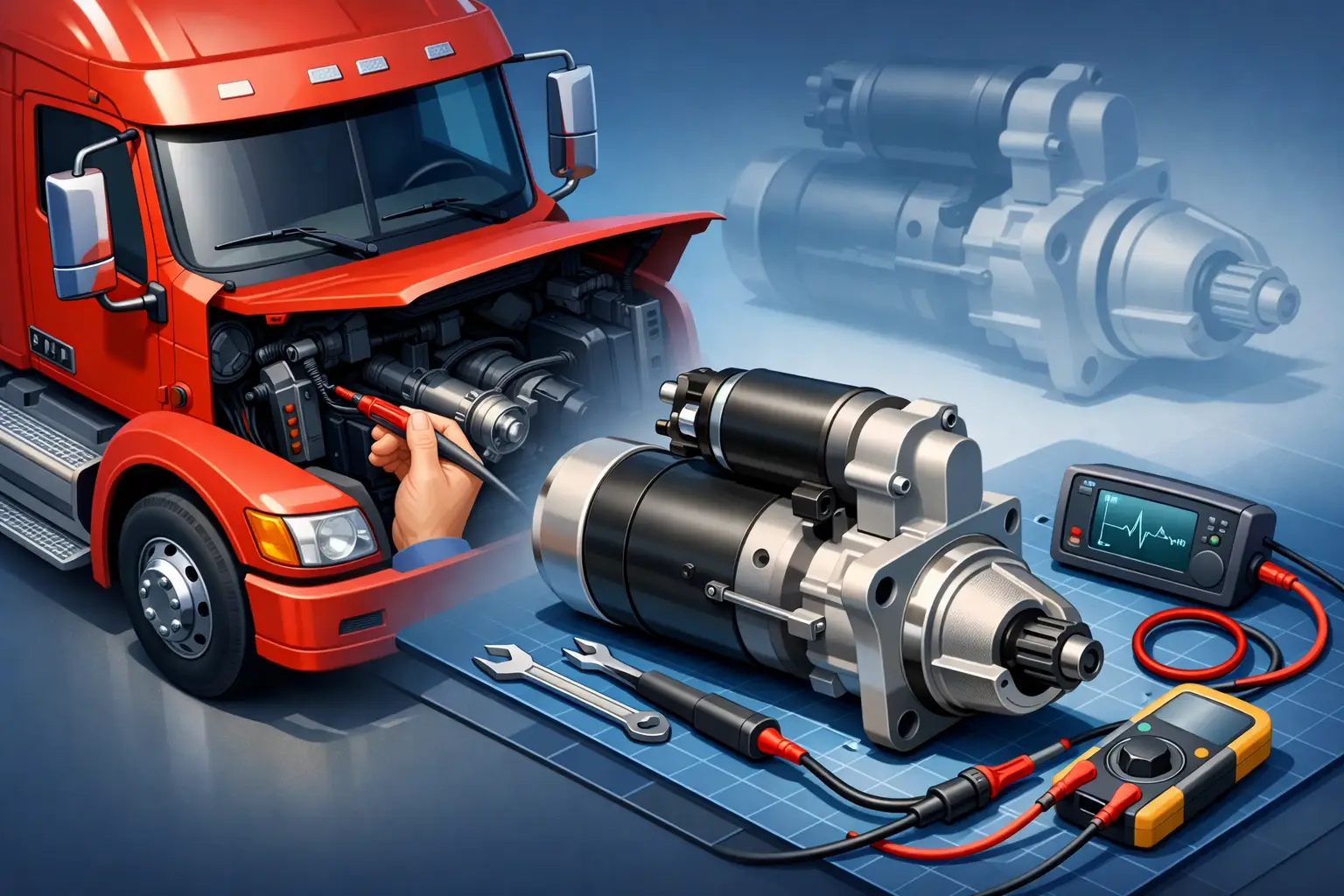
A truck that will not crank can burn half a day before you have even moved the first load. If you are working out how to troubleshoot truck starter motor faults, the key is not guessing – it is following a quick, logical sequence that tells you whether the problem is the battery, wiring, solenoid, starter motor, or something upstream in the control circuit.
Starter problems are often blamed on the motor itself, but that is only part of the picture. On heavy vehicles, a no-start complaint can come from voltage drop, poor earths, a faulty relay, a worn ignition switch, or even a safety interlock. Replacing the starter before checking the basics can waste money and leave the truck off the road for no reason.
How to troubleshoot truck starter motor faults properly
Start with the symptom, because the sound the truck makes – or does not make – matters. A single click points you in a different direction to a slow crank, rapid clicking, or complete silence. That first clue helps narrow the job down quickly.
Before testing anything, make the vehicle safe. Park on level ground, apply the park brake, isolate if required, and keep clear of moving parts. If the truck has recently been running, remember that batteries, starter cables and the motor itself can be hot.
If there is no crank and no click
When you turn the key and get nothing at all, start at the battery bank. Check voltage first, but do not stop there. A battery can show decent standing voltage and still fall over under load.
Look for loose terminals, corrosion, damaged lugs or heat marks around the cable ends. On trucks, battery connections cop vibration, weather and grime, so a poor connection is common. Pay close attention to the earth side as well. A bad chassis earth can mimic a failed starter motor.
If battery condition and terminal security look acceptable, move to the start signal side. Check whether the starter solenoid is receiving a trigger signal when the key is turned to start. If there is no trigger voltage, the fault may sit in the ignition switch, start relay, neutral safety circuit, clutch switch, immobiliser, or associated wiring.
This is where proper testing matters. You are not just asking whether power exists. You are checking whether it arrives at the right point, at the right time, and under load.
If there is a click but no crank
A click usually means the solenoid is trying to engage. That narrows the fault, but it does not confirm the starter motor is healthy. The problem may still be low battery voltage, excessive voltage drop on the main positive cable, a poor earth, seized engine resistance, or worn internal starter contacts.
Check battery voltage during crank request. If it drops sharply, suspect weak batteries, poor battery condition, or a high-resistance connection. If voltage remains reasonable but the starter does not turn, test voltage at the main starter terminal and across the earth path. Excessive voltage drop on either side can stop a starter doing its job.
A common trap is replacing batteries because the truck clicks. Sometimes the batteries are fine and the real issue is a cable that looks sound outside but is corroded internally. Heat damage near a lug is another giveaway.
If the engine cranks slowly
Slow crank is often electrical, but not always. Start with battery condition, state of charge, and cable integrity. Heavy vehicles need serious current to crank properly, and even minor resistance in the circuit can drag speed down.
Then consider the mechanical side. Thick oil in cold conditions, internal engine problems, or an accessory dragging badly can make a starter appear weak. If electrical test results are borderline, you need to separate whether the starter is struggling because of supply issues or because the engine is unusually hard to turn.
A starter that gets hot quickly, draws excessive current, or smells burnt may have internal wear. Brushes, bearings, armature faults and solenoid contact wear all show up over time, especially on trucks doing frequent stop-start work.
The checks that save the most time
If you want a fast answer on how to troubleshoot truck starter motor issues, focus on three areas first: battery supply, cable condition and voltage drop, and trigger signal to the solenoid. Those checks eliminate a large share of faults without pulling parts off the vehicle.
Battery and supply voltage
Do not rely on age alone. A fairly new battery can still be discharged, sulphated, or damaged by repeated deep cycling. Test open-circuit voltage, then check what happens while trying to crank. A healthy system should hold up under load. If voltage collapses, the batteries or their connections deserve attention before the starter is condemned.
On fleet vehicles, this matters even more because repeated short trips, PTO use, refrigeration loads or auxiliary equipment can affect charge condition without obvious warning.
Cable and earth integrity
Starter motors draw high current. That means even a small amount of resistance in a terminal, isolator, fusible link or earth strap can create major trouble. Visual checks help, but they are not enough on their own.
Voltage drop testing is the better approach. Test the positive side while cranking, then the earth side. High readings point to resistance in the path. It is a practical way to find faults that a basic continuity test will miss.
Solenoid trigger circuit
If the main supply is good but the solenoid is not getting its start signal, the starter motor may have nothing wrong with it. On modern trucks, that signal may pass through relays, body control functions, neutral safety logic, or anti-theft systems before it reaches the starter.
That is why one no-crank truck can be a straightforward battery issue and the next can need proper electrical diagnostics. It depends on the vehicle, the wiring layout and what control systems are involved.
When the starter motor itself is the problem
After supply, earth and trigger checks are done, the starter motor becomes the likely suspect. Typical internal faults include worn brushes, burnt commutator segments, failed solenoid contacts, seized bearings or an open circuit in the windings.
You may also hear grinding, harsh engagement noise or intermittent cranking. Intermittent faults are especially common with worn solenoid contacts. The truck starts fine one time, then only clicks the next.
Bench testing can help, but it has limits. A starter may spin on the bench and still fail under real engine load. In-vehicle testing gives a clearer picture because it shows how the unit behaves in the actual circuit.
Common mistakes when diagnosing a truck starter issue
The biggest mistake is replacing the starter motor first. It is understandable under pressure, especially when the truck is booked and the job needs to move, but it is not always the smartest call. If the root cause is low voltage, a bad earth, or a control-side fault, the new starter will not fix the problem.
Another mistake is ignoring intermittent issues. If the truck has occasional slow crank, random clicks or heat-related no-start complaints, catch it early. These faults usually get worse, not better.
It is also worth checking for signs of repeat failure. If a starter has been replaced more than once, ask why. Oil contamination, poor battery maintenance, charging issues, damaged flywheel teeth, or chronic voltage drop can shorten starter life.
When to call an auto electrician
Some checks are practical to do on site, especially battery inspection, visible cable checks and basic voltage testing. But if the truck still will not crank after the obvious faults are ruled out, proper diagnostics save time.
That is particularly true for commercial vehicles where downtime costs more than the repair. A technician with the right equipment can confirm whether the issue is in the starter circuit, the control side, or elsewhere in the vehicle electrical system without swapping parts and hoping for the best.
For operators in Auckland, mobile support can make a real difference when a truck is stuck in the yard, on site, or unable to get back to the workshop. Simms Electrical handles this kind of fault finding regularly, which matters when you need an answer quickly rather than a rough guess.
A practical way to think about starter faults
Treat the starter system as a chain. The batteries need to supply current, the cables and earths need to carry it, the control circuit needs to trigger it, and the starter motor needs to convert it into cranking force. If any link in that chain is weak, the truck may not start.
That is why the best approach is steady and methodical. Listen to the symptom, test the supply, check voltage drop, confirm the trigger, then judge the starter itself. Done in that order, you are far more likely to find the real fault quickly and get the vehicle back to work with less wasted time.